
Youth

The Youth Committee was established in 1973 as a standing committee of Religions for Peace Japan, with the purpose of nurturing young people and advancing public interest activities for peace. Its mission is to foster youth leadership and promote peace initiatives from the perspectives and unique capacities of young people.
Led by future leaders of Japan’s religious communities, the Committee provides a platform where youth from diverse backgrounds and faith traditions come together to share insights, deepen their experiences, and cultivate mutual understanding. Through domestic and international exchanges, members strengthen friendships while taking on new challenges, preparing themselves to become “peacemakers” who bring fresh perspectives to society.
The Committee has organized Japan–Korea Youth Leaders Exchange Programs, enabling young leaders of both countries to build relationships across religious and cultural boundaries. It also participates in the Asia-Pacific Interfaith Youth Network (APIYN) camps, where youth leaders from across the Asia-Pacific region actively engage in dialogue and explore concrete actions that young people can take for peace.
Women

Women’s Committee, established in 1981, is a standing committee that addresses issues of “life” from the perspectives of women of diverse religious traditions. Through seminars, study sessions, and public messages, the Committee provides a space to learn together and share voices of faith for peace and dignity.
Its activities are guided by four key visions:
- Standing with those experiencing isolation or loneliness, and giving voice to the voiceless
- Speaking on behalf of those who do not fit into existing categories
- Sharing messages widely through national and international networks
- Strengthening interreligious networks at the global, Asian, and national levels
In response to voices from mothers of children with disabilities after the 2011 Great East Japan Earthquake, the Committee published a practical guide (“Tebiki”) encouraging religious facilities—often used as evacuation centers—to prepare to welcome persons with developmental disabilities. This initiative is part of its ongoing advocacy work to build inclusive and compassionate communities in times of crisis.
The Women’s Committee organizes annual Learning Sessions on the Dignity of Life, exploring issues such as education, poverty, healthcare, and bioethics with insights from experts. In addition, through Interreligious Learning Visits to diverse faith communities across Japan, members engage in practices, dialogues, and study programs that foster appreciation of religious diversity and the possibilities of peaceful coexistence.
Peace
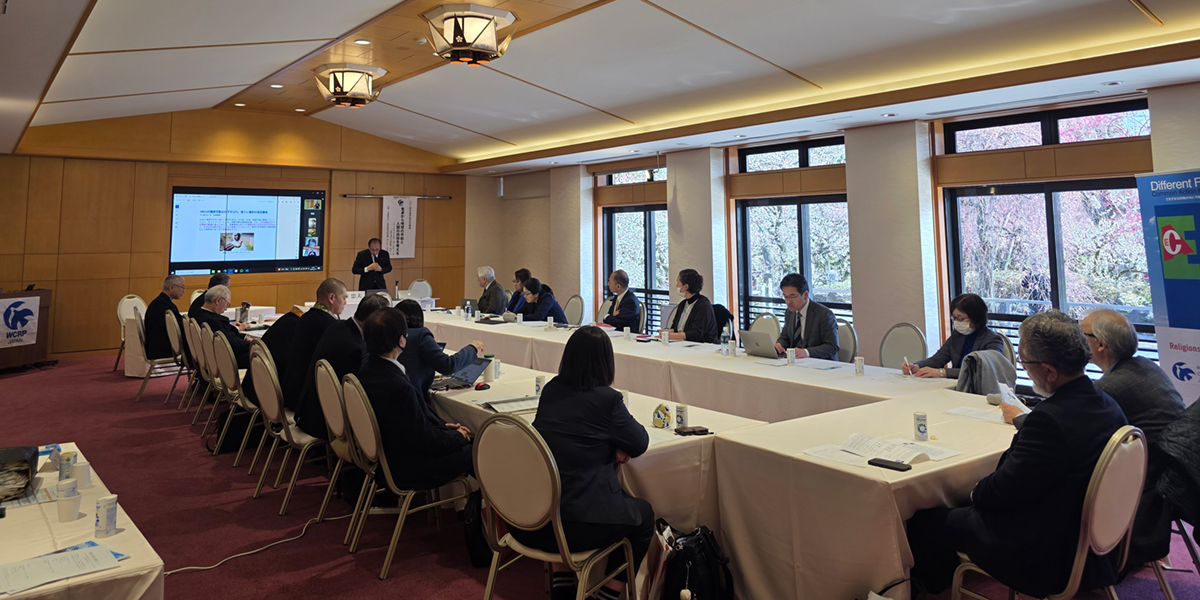
The Peace Research Institute was established in 1977 as a research body of Religions for Peace Japan to promote interreligious, interdisciplinary, and international studies on religion and peace, contributing to the organization’s mission and activities. Today, researchers with backgrounds in Islam, Christianity, Shinto, Buddhism, and other faiths continue to conduct studies aimed at advancing peace.
The Institute also holds regular annual research study session, bringing together insights across religion, academia, and society to share knowledge that contributes to peacebuilding. The outcomes are published in the journal WCRP and in the Institute’s annual bulletin Religion for Peace: Dialogue and Cooperation, of which about 450 copies are produced and approximately 350 are distributed free of charge to religious leaders, universities, research institutes, libraries, and media organizations.