The WCRP Japan Women’s Committee hosted a “Study Session on Life” on March 7, 2026
Learning About Life and Peace Through Fieldwork Insights
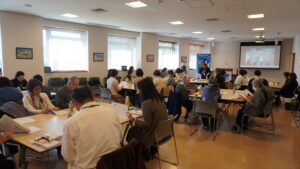
The Women’s Committee of the WCRP Japan Committee held a “Study Session on Life” on Saturday, March 7, 2026, at Kibe Hall (Yotsuya, Tokyo). A total of 64 people participated, including 39 attending in person and 25 joining online.
The Women’s Committee has long engaged in dialogue on various issues concerning “life” from the perspective of women of faith. This study session built upon insights gained through a religion-specific study session and fieldwork conducted in Okinawa last October.
Okinawa, once the Ryukyu Kingdom with its own unique history and culture, is also the only region in Japan where ground battles were fought during World War II. After the war, it remained under U.S. military administration for 27 years. Even today, it hosts a high concentration of U.S. military bases in Japan. As such, Okinawa is a region where historical experiences and contemporary social issues intersect.
This study session aimed to deepen understanding of Okinawa’s history and current realities, while providing a space to share insights gained through fieldwork and reflect on how each of us can translate these learnings into action.
In the first part of the program, members of the Women’s Committee and participants in the religious study group reported on their fieldwork in Okinawa. Participants visited sites such as Okinawa Peace Memorial Park and the Himeyuri Peace Memorial Museum, engaging with the memories of the Battle of Okinawa while learning about ongoing postwar issues, including base-related challenges and human rights concerns. Through dialogue programs with Okinawan women and religious leaders, they listened to the voices of people who continue working for peace while confronting the legacies of war and the presence of military bases.
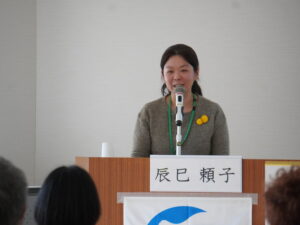
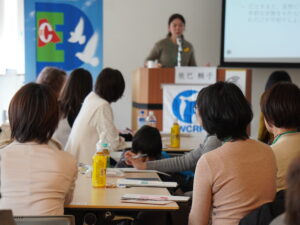
In the second part, Professor Yoriko Tatsumi of the Faculty of Global Citizenship Studies at Seisen University delivered a lecture titled “Connecting Fieldwork Learning to Action.” Professor Tatsumi introduced the concept of “peace-making,” explaining that it highlights the everyday practices and actions through which people create peaceful conditions in their daily lives. She noted that recognizing such “peace-making” actions is closely connected to the process of “learning,” “feeling,” and “acting” when engaging with social issues.
She also introduced “participant observation,” a key method in cultural anthropology, emphasizing the importance of immersing oneself in the daily lives of local people and deepening understanding through shared experiences.
Professor Tatsumi explained that fieldwork is not simply about interviewing local people to gather information. Rather, it is an experiential learning process in which one places oneself within a particular environment in order to better understand how people live and what they experience in their everyday lives. She also stressed the importance of viewing Okinawa’s issues not as distant events, but through a perspective that connects them to our own society and ways of living.
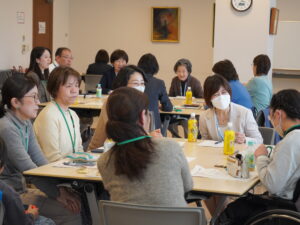
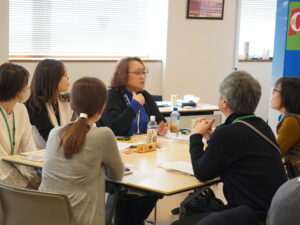
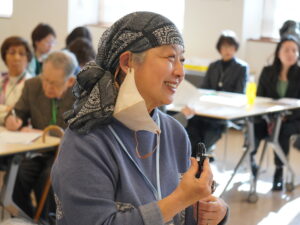
In the third part, participants divided into small groups for dialogue, sharing their reflections and discussing possible actions going forward. Participants offered comments such as:
“I felt the need to learn again about Okinawa’s history and current situation.”
“I want to think about peace not as something distant, but as a personal issue.”
Through this study session, participants deepened their understanding of Okinawa’s history and present circumstances while reflecting on how each of us can take action toward realizing peace. The Women’s Committee will continue to create opportunities for dialogue and learning that encourage reflection on life and peace.