
WCRP Japan Women’s Committee Holds Interreligious Study Program in Okinawa
Event Report: WCRP Japan Women’s Committee Holds Interreligious Study Program in Okinawa
Weaving Prayer and Action from the Land of Okinawa
23–25 October 2025
The Women’s Committee of the WCRP (Religions for Peace) Japan held its annual Interreligious Study Program in the central and northern regions of Okinawa Prefecture from 23 to 25 October 2025.
For many years, the Women’s Committee has visited member and affiliated religious communities of WCRP Japan to learn about their histories, teachings, and peace activities, while fostering mutual understanding across traditions. Among these efforts, the Interreligious Study Program has become a central learning opportunity for exploring practical approaches to coexistence and peace beyond religious and cultural boundaries.
Okinawa—the site of this year’s program—is the only region in Japan to have experienced a ground war during World War II. Its people continue to carry deep historical wounds, while also preserving the rich cultural heritage of the former Ryukyu Kingdom. Encountering this history and culture is not merely an act of remembrance; it offers profound insights into the dignity of life and raises critical questions for contemporary society.
The program was organized with the hope that each participant would reflect on the dignity of every life, reconsider what it means to live together across religions, cultures, and social positions, and deepen their commitment to multicultural coexistence, gender equality, and nonviolence.
A total of 15 participants, including members of the Women’s Committee, gathered to meet local religious leaders and community members. Through prayer and dialogue, participants deepened their understanding of “peace learned from Okinawa.”
Day 1: Encountering Okinawa’s Religious and Peace Sites
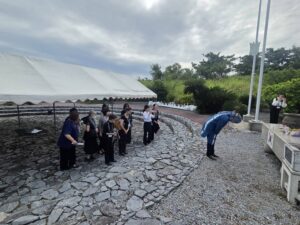 Although rain had been forecast, the sky cleared upon arrival at Naha Airport, and a gentle light enveloped the group as if responding to their prayers.
The first day began with a visit to the Peace Memorial Park in Itoman City. Participants offered flowers and silent prayers at the National Okinawa War Mausoleum, the Cornerstone of Peace, and the Korean Memorial Tower, honoring all whose lives were lost in war.
The Women’s Committee offered deep respect and prayers for lives taken in every conflict, across all nationalities, cultures, and religions. Standing there, participants reflected anew on history and reaffirmed the foundations of peace.
“Dialogue can only be built upon trust.”
The Women’s Committee reaffirmed its commitment to nurturing trust as the essential foundation for continued dialogue.
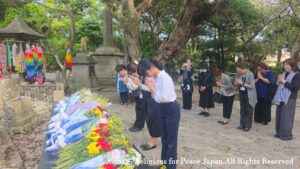 The group then visited the Himeyuri-no-to Monument, where three young women representing the Committee offered flowers and prayers in memory of students and teachers of the Okinawa Normal School Women’s Division and the First Prefectural Girls’ High School who perished during the Battle of Okinawa. Their sacrifice, made at such a young age, reminded participants of the importance of carrying their hopes for peace into the future.
Day 2: Testimonies, Dialogue, and Reflecting on 80 Years Since the War
The second day featured the program’s main event: a dialogue session under the theme,
“Reflecting on Life from Postwar Okinawa: Carrying the Voices of Women and Religion into the Future.”
The session was held at the Okinawa Diocese of the Nippon Sei Ko Kai (Anglican Church in Japan) in Urasoe and welcomed approximately 80 participants onsite and online.
Four speakers offered reflections from their distinct experiences and perspectives:
-
Ms. Suzuyo Takazato, Co-Representative, Okinawa Women Act Against Military Violence
-
Rev. Shizuko Shima, Uhazato Church, United Church of Christ in Japan, who moved to Okinawa and has walked alongside local communities
-
Ms. Naoko Oomine, Member of Rissho Kosei Kai Okinawa Dharma Center. She is 100 years old, who survived the war as a student worker
-
Ms. Naoko Nakamura, also Member of Rissho Kosei Kai Okinawa Dharma Center.
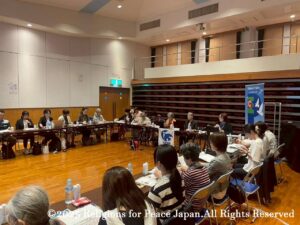 Ms. Takazato spoke about the history of the Ryukyu Kingdom, civilian suffering during the Battle of Okinawa, and the severe human rights violations caused by U.S. military bases after the war. Recalling the protest movement of 85,000 people following the rape of a young girl, she emphasized the importance of survivors raising their voices and stated that “silence enables violence,” calling for the removal of military bases and progress toward gender equality.
Rev. Shima reflected on the pain of “Okinawan discrimination” and the loss of identity, reminding participants that every life lost in war had a “name and a story.” She shared her experience as captain of a protest boat, standing on the sea day after day, the natural world strengthening her resolve not to allow another death from war nor leave military bases to future generations.
 Ms. Naoko Oomine, who turned 100 this year, quietly recounted her experience working for the 32nd Army Headquarters and later serving in a field hospital. She spoke of the weight of “life” felt when gazing at soldiers’ family photographs in the darkness of the caves, and of sewing dresses for American soldiers after the war—an experience she described as “yesterday’s enemies becoming today’s friends,” pointing to the seeds of reconciliation.
“To you who live today, I want to pass on a future free from war.”
Her words left a deep impression on everyone present.
The program concluded with a call to strengthen networks with civil society and various organizations and to transform learning into concrete action.
Day 3: Learning from Okinawan Spirituality and Reflecting on the Journey
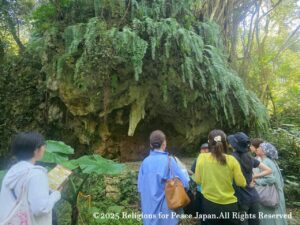 On the final day, participants visited Sefa-utaki, a UNESCO World Heritage site and the most sacred place of the Ryukyu Kingdom.
The term “Sefa-utaki” originates from the Ryukyuan language and cannot be fully translated into Japanese. As the highest sacred site of the kingdom—and historically a space forbidden to men—it is where royal women were ordained as Kikoe-Ōgimi, the highest-ranking priestesses who presided over religious rites.
Today Sefa-utaki is known as a “power spot,” but its meaning lies not in receiving power from outside, but in remembering the spiritual strength already within us. It is a place for offering gratitude to nature, ancestors, and life, and for awakening one’s inner prayer.
For the Women’s Committee, visiting this sacred space created a moment of quiet resonance with generations of women who carried prayer before them, offering an opportunity to reflect anew on “life” and “prayer.”
Following the visit, participants shared insights and learnings from the three-day program. With renewed commitment, they expressed their determination to carry forward the dignity of life witnessed in Okinawa into the future work of the Women’s Committee.
Conclusion
Throughout the three days, participants encountered the prayers, hopes for peace, and resilient spirit that continue to live in Okinawa.
The Women’s Committee extends its heartfelt gratitude to all who supported and contributed to the realization of this Interreligious Study Program.
